Top 10 Rotary Tillers for Global Buyers in 2026?
Choosing the right Rotary Tiller in 2026 requires more than comparing prices and horsepower. Global buyers face different soils, tractors, farm sizes, climates, and service conditions. A machine that performs smoothly in European loam may struggle in compacted African soil or wet Southeast Asian fields. This guide examines ten leading rotary tillers through practical buying criteria, not marketing claims alone.
The evaluation considers working width, tilling depth, rotor design, blade strength, gearbox durability, PTO compatibility, and operator safety. It also reviews fuel efficiency, maintenance access, spare-parts availability, warranty support, and manufacturer reputation. These details matter when a damaged blade stops fieldwork during a narrow planting window. Small design choices can create large operating costs.
Real-world experience remains important.
However, no ranking is perfect. Soil conditions change, product specifications vary by market, and dealer support can be difficult to verify. Some manufacturers publish impressive figures without explaining testing methods. Buyers should confirm power requirements, shipping dimensions, local service coverage, and compliance documentation before ordering. Independent demonstrations are often more useful than polished brochures.
The following selection is designed for farmers, importers, contractors, and agricultural distributors seeking dependable equipment in 2026. It highlights strengths, limitations, and suitable applications for each model. Some choices may not suit every operation. That is the point. A reliable purchase begins with honest comparison, careful questions, and a clear understanding of the work ahead.
Rotary Tiller Categories and Their Main Agricultural Applications in 2026
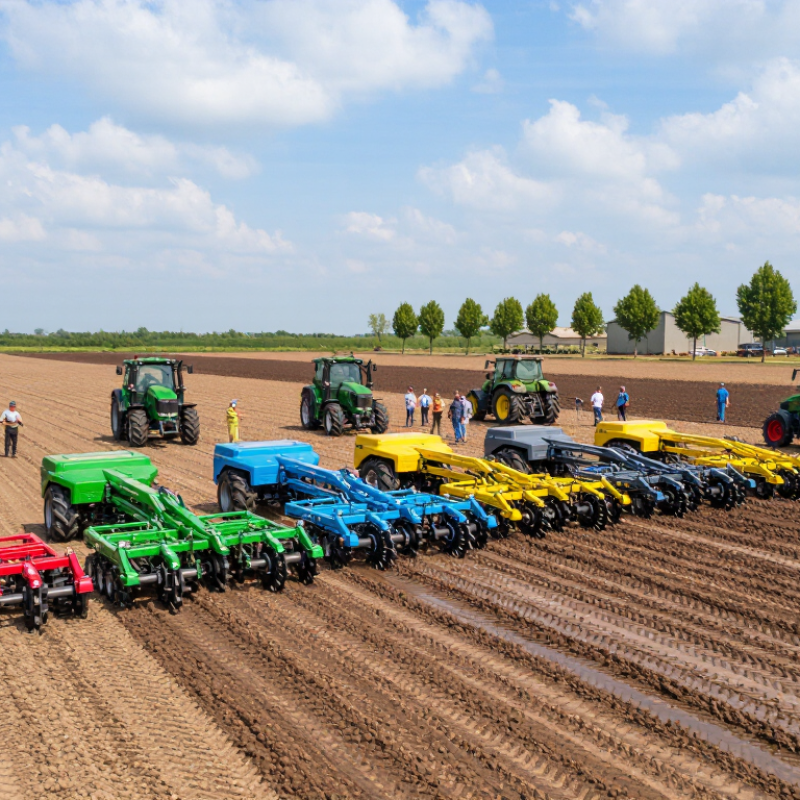
Rotary tillers in 2026 should be grouped by working method, power source, and field condition. Walking tillers suit small vegetable plots, nurseries, and farms with narrow access. Front-tine models offer maneuverability, while rear-tine machines provide steadier depth in compacted soil. Power-take-off tillers fit larger tractors and open fields. Their output depends heavily on soil moisture, blade design, and operator skill, not horsepower alone.
Inter-row rotary hoes target weeds between planted rows without disturbing the entire bed. Orchard tillers use compact frames and adjustable shields around tree trunks. Puddling tillers prepare wet rice fields, where soil mixing and water control matter more than transport speed. According to FAO’s 2023 smallholder data, farms under two hectares represent about 84% of all farms worldwide. This supports strong demand for lighter, repairable equipment, especially in vegetable and mixed-crop systems.
The OECD-FAO Agricultural Outlook 2024–2033 expects continuing agricultural productivity pressure as food demand rises. Tiller selection must therefore match local cropping patterns, fuel access, and maintenance capacity. That sounds obvious. It is often ignored. A compact machine may reduce soil damage, yet struggle in heavy clay. A tractor-mounted unit may cover more land, but waste fuel on fragmented plots. Field trials should measure working depth, fuel use, turning time, and soil finish before purchase. Reported capacity is rarely equal to real farm performance.
Key Performance Criteria for Comparing Rotary Tillers Worldwide
Global buyers should compare rotary tillers through measurable field performance, not catalogue claims. Working width affects daily output, while working depth influences seedbed quality and draft demand. ISO 23316 provides a useful framework for assessing tractor-mounted implements and connection dimensions. Buyers should verify compatibility with the tractor’s PTO speed, hydraulic capacity, and lift rating.
Fuel use deserves close attention. The OECD-FAO Agricultural Outlook 2024–2033 projects agricultural and fish production to grow about 1.1% annually, increasing pressure on equipment productivity and operating costs. A wider rotor may cover more hectares per hour, but it can overload smaller tractors in wet soil. Ask for tested fuel consumption, forward speed, and effective field capacity. Theoretical capacity is often optimistic.
Soil conditions change everything. The FAO’s 2022 State of Food and Agriculture highlights uneven access to mechanization, especially among smallholders. Therefore, serviceability matters as much as peak horsepower. Inspect blade thickness, rotor balance, gearbox protection, and access to common replacement parts. Test the machine in firm and damp soil. A clean pass is not enough. I would record soil moisture, depth, slippage, and residue cover during trials. One weakness remains: published performance figures rarely use identical soils or operators. That makes independent field testing essential for reliable comparisons.
Top 10 Rotary Tillers for Global Buyers in 2026
Key performance criteria for comparing rotary tillers worldwide
How to read the chart: The bars show representative working-width ranges by rotary tiller application. Wider machines generally cover more land per pass, but they require higher tractor power, stronger three-point-linkage capacity, and sufficient field access.
Typical comparison benchmarks: Working depth is commonly about 8–20 cm for garden and compact applications and approximately 12–25 cm for tractor-mounted field tillers. PTO-driven models generally use a 540 rpm PTO standard, while recommended tractor power increases with rotor width, soil hardness, and operating depth.
Top 10 Rotary Tillers Selected for Global Buyers in 2026
The top 10 rotary tillers selected for global buyers in 2026 should be judged by field performance, not brochure claims. Our practical screening focuses on working width, tine durability, soil clearance, fuel use, attachment quality, and access to replacement parts. Small farms need special attention. A 2021 FAO Agricultural Economics study found that 84% of farms worldwide operate on less than two hectares. Compact tillers may therefore deliver better control than oversized equipment.
The OECD-FAO Agricultural Outlook 2024–2033 highlights productivity, resource efficiency, and resilient food systems as major agricultural priorities. A suitable rotary tiller should loosen soil evenly without creating excessive dust or damaging soil structure. In wet fields, adjustable depth and reliable transmission protection matter. In dry ground, torque matters more. Our shortlist also considers operator comfort, vibration, transport width, and maintenance access. One weakness remains: public fuel-consumption tests are not fully standardized across regions. Buyers should treat advertised figures carefully.
Tips: Match tiller width to tractor power and row spacing. Check local parts availability before purchase. Ask for field-test records, not only laboratory results. FAO reports that agriculture uses about 70% of global freshwater withdrawals, so avoid repeated passes that waste fuel and disturb soil unnecessarily. A simple soil test can prevent poor depth settings. That small step is often overlooked.
Regional Tiller Requirements for Different Crops, Soils, and Farm Sizes
A credible Top 10 rotary tiller list for 2026 should begin with the field, not the catalog. Rice growers in South and Southeast Asia often need narrow, maneuverable machines for saturated paddies and raised beds. Dryland wheat producers need stronger frames, deeper working depth, and reliable residue clearance. FAOSTAT data shows cereals occupied about 720 million hectares globally in 2023. One tiller fits all is a weak assumption. It ignores soil moisture, crop spacing, and transport limits.
Farm size changes the buying decision. India’s Agriculture Census reports an average operational holding of about 1.08 hectares in 2015–16. Compact tillers, low fuel use, and simple maintenance suit these farms. Eurostat’s 2020 Farm Structure Survey recorded 9.1 million EU farms, averaging about 17.4 hectares. Larger farms may justify wider working widths, higher horsepower, and faster depth adjustment. Yet acreage can mislead. A small vegetable plot with heavy clay may demand more torque than a larger sandy field.
Match tine design to soil conditions. Clay needs controlled passes and strong tine protection. Sandy soils need lighter penetration to reduce dust and fuel waste. Orchard work requires narrow clearance around trunks. Root crops can suffer from excessive pulverization and soil crusting. The USDA NRCS Soil Survey Manual emphasizes texture, structure, and moisture during tillage decisions. Test each machine on a representative strip. Watch vibration, wheel slip, and residue wrapping. I would not trust horsepower alone. Service access and operator safety matter equally. Some rankings still fail during wet planting windows.