Global fertilizer demand is rising, while buyers face tighter margins, water concerns, and uneven field conditions. The International Fertilizer Association’s Medium-Term Fertilizer Outlook 2024–2028 projects demand could approach 205 million tonnes of nutrients by 2028. That growth increases the importance of accurate application, not simply larger equipment.
A reliable Fertilizer Applicator should match field size, crop requirements, terrain, and local service support. FAO research continues to highlight nutrient-use efficiency as a practical path toward higher productivity and reduced environmental losses. Variable-rate systems, calibrated spreaders, liquid injectors, and air-assisted machines can place nutrients more precisely. Small details matter. A blocked nozzle can leave visible stripes across a wheat field. Uneven spreading can reduce yield several rows away.
Dr. John Fulton, a precision-agriculture specialist at The Ohio State University, describes the core principle clearly: “Precision agriculture is about managing variability in the field.” That idea guides this selection of the 10 best fertilizer applicators for global buyers. The list considers application accuracy, capacity, calibration, maintenance, operator visibility, and compatibility with digital farm systems. It also considers dealer networks and replacement-part access. These factors are easy to overlook.
No ranking fits every farm. A high-capacity machine may be excessive for a small operation. A lower-cost applicator may require more manual calibration. Buyers should question impressive specifications and request field-test evidence. Performance can change with fertilizer density, humidity, slope, and driving speed. The best choice is not always the most expensive one. It is the machine that delivers consistent results in real working conditions.
For global buyers, “best” depends on crop spacing, field size, soil moisture, and service access. The International Fertilizer Association’s 2024 outlook places global fertilizer demand near 200 million tonnes of nutrients annually. That scale makes accurate application more than a purchasing preference.
Ten common applicator types serve different jobs.
Field experience shows calibration matters more than appearance. A simple collection-tray test can reveal uneven flow within minutes. Check belt speed, gate opening, nozzle wear, and driving speed before each season. The Food and Agriculture Organization links balanced nutrient management with improved productivity and reduced nutrient losses, but equipment alone cannot create balance. That is the difficult part. Wet granules may bridge inside a hopper. Dusty material may drift beyond the target strip. Remote buyers should request test data, spare-part availability, and local calibration guidance. One weakness remains: digital rate control can be impressive, yet poor soil maps still produce poor decisions.
Choosing among the 10 best fertilizer applicators requires more than comparing prices. Global buyers should examine hopper capacity, spreading width, metering accuracy, and power requirements. A large hopper can reduce refilling time, but it may increase soil compaction on smaller fields. Adjustable spread patterns matter too. They help operators manage field edges and avoid wasted fertilizer.
During field evaluations, I check whether settings remain stable on rough ground. A clear calibration scale is essential. Moisture, fertilizer size, and travel speed can change the application rate. Stainless or well-protected components usually handle corrosive materials better. Easy access to gears, belts, and outlets also reduces maintenance delays. However, no applicator performs perfectly in every condition. I once focused too heavily on capacity and underestimated cleaning time.
Tips: Test the applicator with the actual fertilizer before purchase. Measure output from several outlets, not just one. Check whether local technicians can supply replacement parts. Review the user manual for calibration steps, safe loading limits, and compatible tractors. Buyers should also confirm transport dimensions, electrical requirements, and relevant safety documentation for their region. Small details matter. A model that fits the budget may still waste product if its controls are difficult to adjust. Clear instructions, reliable construction, and repeatable performance should guide the final comparison.
The chart compares representative specifications for widely used fertilizer applicator categories. Working width is shown in meters, while hopper or tank capacity is shown in hundreds of liters. Larger broadcast, pneumatic, air-cart, and liquid-boom systems generally provide higher field capacity, while drop, strip-till, and mounted systems offer more targeted application and lower transport requirements. Actual specifications vary by configuration, fertilizer type, terrain, and regional regulations.
For small vegetable plots, handheld spreaders and compact drop applicators offer precise control. They fit narrow beds and reduce fertilizer falling onto paths. A small farm can also use a walk-behind broadcast unit for grains, pasture, or open vegetables. Choose a hopper that remains stable on uneven ground. Calibration matters more than appearance.
Medium farms often need tractor-mounted broadcast spreaders, spinner units, or liquid boom applicators. Spinner spreaders cover broad cereal fields quickly, but wind can distort the pattern. Boom systems suit row crops when operators need consistent liquid placement. For orchards, side-delivery or directed applicators can place nutrients near tree roots. Check nozzle flow, row spacing, and ground speed before each application. Small errors become expensive across 50 hectares.
Large operations may select high-capacity pneumatic or air-assisted systems for uniform delivery. These applicators work well with broad-acre crops, orchards, and carefully managed nutrient programs. Digital rate control improves traceability, but sensors still need cleaning and verification. Soil tests should guide the fertilizer rate, not habit. I have seen operators trust factory settings too much. That is an avoidable weakness. Buyers should compare local service, spare-part access, tank materials, and legal application limits before purchase. A cheaper unit may fail if local technicians cannot support it.
10 Best Fertilizer Applicators for Global Buyers
Global buyers should judge capacity against field size, travel distance, and refill access. The International Fertilizer Association’s 2024 Medium-Term Fertilizer Outlook projects global nutrient demand near 205 million tonnes by 2028. That scale does not justify buying the largest machine. Oversized hoppers can increase axle loads, fuel use, and soil compaction. Smaller farms may gain better control from compact spreaders or nurse-tank systems. Fit matters.
Compatibility begins with fertilizer form. Granular products need suitable metering gates, agitators, and corrosion-resistant contact parts. Liquid systems require compatible pumps, seals, hoses, and flow meters. FAO fertilizer data show major differences in nutrient use across regions, so one universal setup is unrealistic. Humid coastal storage may cause caking, while dry regions can create dust and uneven distribution. A machine should match local fertilizer density, moisture, row spacing, and power supply.
Local conditions often decide performance more than advertised capacity. USDA agricultural statistics show wide variation in farm size and field structure between countries. Narrow plots may favor mounted equipment, while large fields may justify pull-type applicators with section control. Check road width, workshop skills, spare-part availability, and calibration tools before ordering. I would not trust a catalogue rate alone. A field test is safer. Measure twice. Operators should record spread patterns, overlap, wind speed, and actual output. Even experienced teams miss calibration after changing fertilizer batches.
Selecting a fertilizer applicator starts with field conditions, not catalog claims. The International Fertilizer Association’s Fertilizer Outlook 2024–2028 projects global nutrient demand to approach 205 million tonnes by 2028. That scale makes accurate application increasingly important. Match the machine to fertilizer type, working width, terrain, and tractor capacity. Check hopper size and corrosion resistance. A simple calibration test matters more than an impressive specification.
Operate at a steady speed and maintain consistent overlap. Before spreading, weigh material from each outlet for a measured distance. Compare the result with the target rate. Wind, humidity, and uneven granules can quickly change distribution. The Food and Agriculture Organization’s World Food and Agriculture Statistical Yearbook highlights continuing pressure to improve input efficiency. In practice, this means avoiding heavy bands beside depleted strips. Small errors become expensive across thousands of hectares.
Maintenance should be routine, visible, and recorded. Empty the hopper after use. Wash fertilizer residue from screens, discs, chains, and frames. Dry every metal surface before storage. Inspect bearings, vanes, seals, and hydraulic connections weekly during peak use. A worn vane may create an unnoticed yield penalty. I have found calibration can drift after only a few working days. That is easy to underestimate. Keep a log of material type, rate, speed, weather, and repairs. The record may reveal problems that operators miss in the field.
| Rank | Applicator Type | Best Use Case | Typical Capacity | Working Width or Output | Compatible Fertilizer | Power / Mounting | Typical Application Accuracy | Operating Guidance | Maintenance Priorities |
|---|---|---|---|---|---|---|---|---|---|
| 1 |
Variable-Rate Spinner Spreader
Best all-round field option
|
Large arable fields requiring fast granular fertilizer distribution and electronic rate adjustment. | 800–4,000 L hopper volume Approximately 600–3,200 kg, depending on bulk density |
12–36 m broadcast width | Granular urea, ammonium nitrate, compound fertilizers, and blended products | Tractor three-point linkage or trailed chassis; usually 540 rpm PTO or hydraulic drive | Typically ±5–10% after correct calibration; improved with weighing and speed sensors | Calibrate using the actual fertilizer lot. Maintain constant travel speed, verify vane settings, and avoid spreading in strong crosswinds. | Empty the hopper after use, wash and dry corrosion-prone parts, inspect vanes and agitators, and check hydraulic or PTO components. |
| 2 |
Drop Spreader
Best for high placement precision
|
Small and medium fields, turf, vegetable beds, and situations where fertilizer must remain within defined rows or strips. | 100–1,000 L | 0.6–3.0 m effective width | Uniform granular and prilled fertilizers; less suitable for damp or irregular material | Push, pull, or tractor-mounted models; generally low power demand | Often ±3–8% when walking or driving speed is consistent | Overlap passes carefully, set the gate opening according to a measured catch test, and avoid operating over wet ground that may cause wheel tracking. | Clean metering openings, inspect the gate and rollers, lubricate bearings, and store the unit in a dry location. |
| 3 |
Pneumatic Air-Boom Spreader
Best for uniform wide spreading
|
Large-scale grain and oilseed production where a long boom and consistent distribution are important. | 1,000–5,000 L | 18–48 m boom width | Granular fertilizers and some microgranular products, subject to metering-system compatibility | Tractor-mounted or trailed; PTO or hydraulic blower with metering rollers | Typically ±3–8% across the boom after calibration | Check fan speed, air pressure, hose routing, and outlet uniformity. Reduce speed or width if the fertilizer is dusty or poorly granulated. | Remove fertilizer dust from the fan and metering system, inspect hoses for blockage, and check boom folding and support points. |
| 4 |
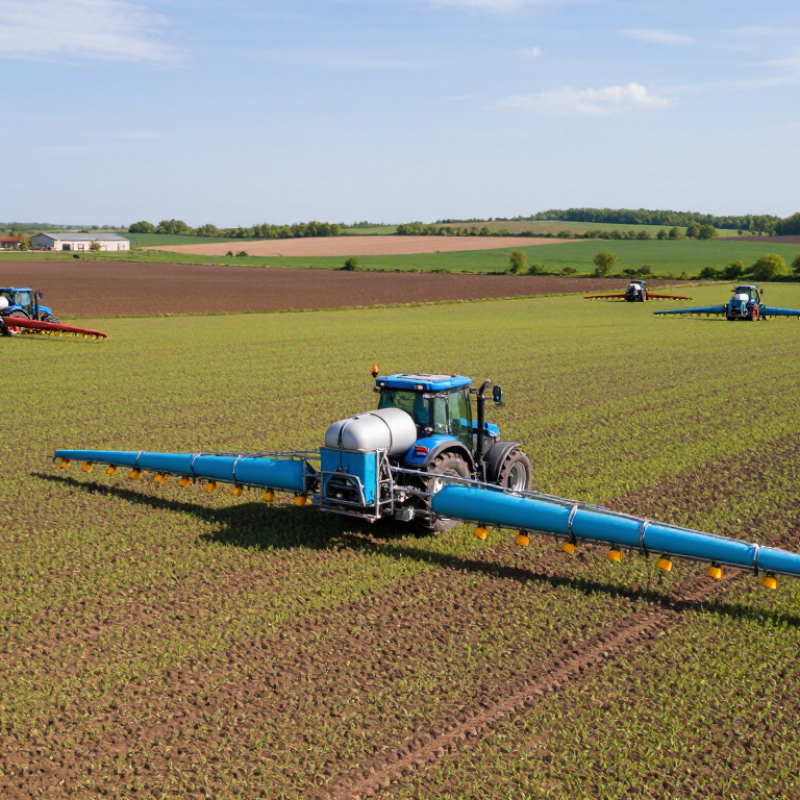
Liquid Fertilizer Boom Sprayer
Best for foliar and starter feeding
|
Uniform application of liquid nitrogen, starter solutions, micronutrients, and foliar fertilizer over broad areas. | 600–6,000 L tank volume | 12–40 m boom width; output commonly 50–300 L/ha | Water-soluble fertilizers and approved liquid nutrient solutions | Tractor-mounted or trailed; PTO or hydraulic pump, with pressure-regulated nozzles | Often ±5–10% with clean nozzles and stable pressure | Use clean water for mixing, follow label concentration limits, maintain correct boom height, and avoid spraying during excessive wind or heat. | Flush the tank and lines after every use, clean filters and nozzles, inspect seals, and protect the pump from freezing where applicable. |
| 5 |
Fertilizer Drill or Seed-and-Fertilizer Combination
Best for simultaneous seeding
|
Row crops and cereals requiring accurate placement of starter fertilizer during planting. | 500–2,500 L combined seed and fertilizer capacity | 2.5–8.0 m seeding width; row spacing commonly 12.5–25 cm | Granular starter fertilizer, compound fertilizer, and compatible seed products | Tractor three-point or trailed; ground-wheel, hydraulic, or electronic metering | Typically ±5–10% between rows after a stationary calibration test | Keep fertilizer separated from seed when required, maintain correct seedbed depth, and prevent fertilizer from contacting seed at rates that may cause salt injury. | Clean seed tubes and fertilizer outlets, inspect coulters and openers, lubricate chains or bearings, and check metering rollers. |
| 6 |
Side-Dress Cultivator Applicator
Best for in-season row-crop feeding
|
Applying nitrogen or granular fertilizer beside established maize, cotton, vegetables, and other row crops. | 300–1,500 L | 4–12 rows; commonly 0.45–1.00 m row spacing | Granular fertilizer and, with suitable equipment, liquid nitrogen solutions | Tractor-mounted; gravity, ground-drive, hydraulic, or pump-fed metering | Typically ±5–10% with matched row outlets | Set the placement distance from the crop according to crop size and soil condition. Avoid cutting roots, bury fertilizer where possible, and maintain row alignment. | Inspect openers, knives, tubes, row units, and depth controls. Remove fertilizer residues and lubricate moving linkages. |
| 7 |
Conveyor-Belt Manure and Compost Spreader
Best for bulky organic fertilizers
|
Farmyard manure, compost, poultry litter, lime, and other high-moisture or irregular organic amendments. | 8–35 m³ body volume | Typically 2–8 m spreading width; 5–40 t/h output depending on material | Compost, manure, poultry litter, lime, and blended organic amendments | Tractor-trailed; PTO-driven apron and beaters, often with hydraulic controls | Usually ±10–20% because moisture, particle size, and density vary considerably | Use a load-weight estimate or scale where available. Adjust apron speed and beater speed separately, and avoid overloading the body or operating on unstable slopes. | Remove material from the floor and beaters, grease bearings and chains, inspect apron slats, and check gearbox oil and hydraulic hoses. |
| 8 |
Auger Fertilizer Applicator
Best for bulk transfer and banding
|
Loading, transferring, and placing granular fertilizer into bands or directly into planting equipment. | 0.5–4.0 m³ hopper or receiving capacity | Approximately 10–80 t/h transfer rate; band width depends on outlet arrangement | Granular fertilizer, seed, lime, and other free-flowing dry materials | Tractor PTO, hydraulic motor, or electric motor; portable or implement-mounted | Typically ±5–12% after checking auger output over a timed interval | Operate at a steady auger speed, keep the intake free of bridging, and do not use excessive speed that may damage granules or cause segregation. | Clean the tube and flighting, inspect flight wear, grease bearings, check guards, and prevent moisture from entering the hopper. |
| 9 |
Fertigation Injector System
Best for irrigated high-value crops
|
Applying soluble nutrients through drip, micro-sprinkler, or other pressurized irrigation systems. | Concentrate tank: 20–2,000 L; system flow commonly 0.5–100 m³/h | Application rate controlled by irrigation flow and injection ratio | Fully soluble fertilizer products compatible with the irrigation water and equipment | Venturi injector, dosing pump, or proportional injection unit | Often ±2–10% with calibrated dosing and stable water pressure | Test water quality, dissolve fertilizer completely, inject after filtration, and finish with a clean-water flush to clear lines and emitters. | Clean filters and injector components, inspect check valves and seals, prevent crystallization, and verify injection rate regularly. |
| 10 |
Orchard Air-Assisted Applicator
Best for perennial crops
|
Distributing liquid or soluble nutrients through orchard and vineyard rows while directing airflow toward the canopy. | 500–2,000 L tank volume | 1–6 row coverage; commonly 5–15 m effective working width | Liquid fertilizer, micronutrient solutions, and compatible foliar feeds | Tractor-mounted or trailed; PTO-driven fan and pump | Typically ±5–12%, depending on canopy density and airflow adjustment | Match airflow and nozzle output to canopy size, use the lowest effective pressure, and avoid drift beyond the target row or into waterways. | Flush tank, pump, nozzles, and fan housing; inspect fan blades, belts, filters, hoses, and corrosion-prone fittings. |